
accordion to theory, accordion, accordionist
Photo by Hernán Piñera

Anatomy of an Accordion

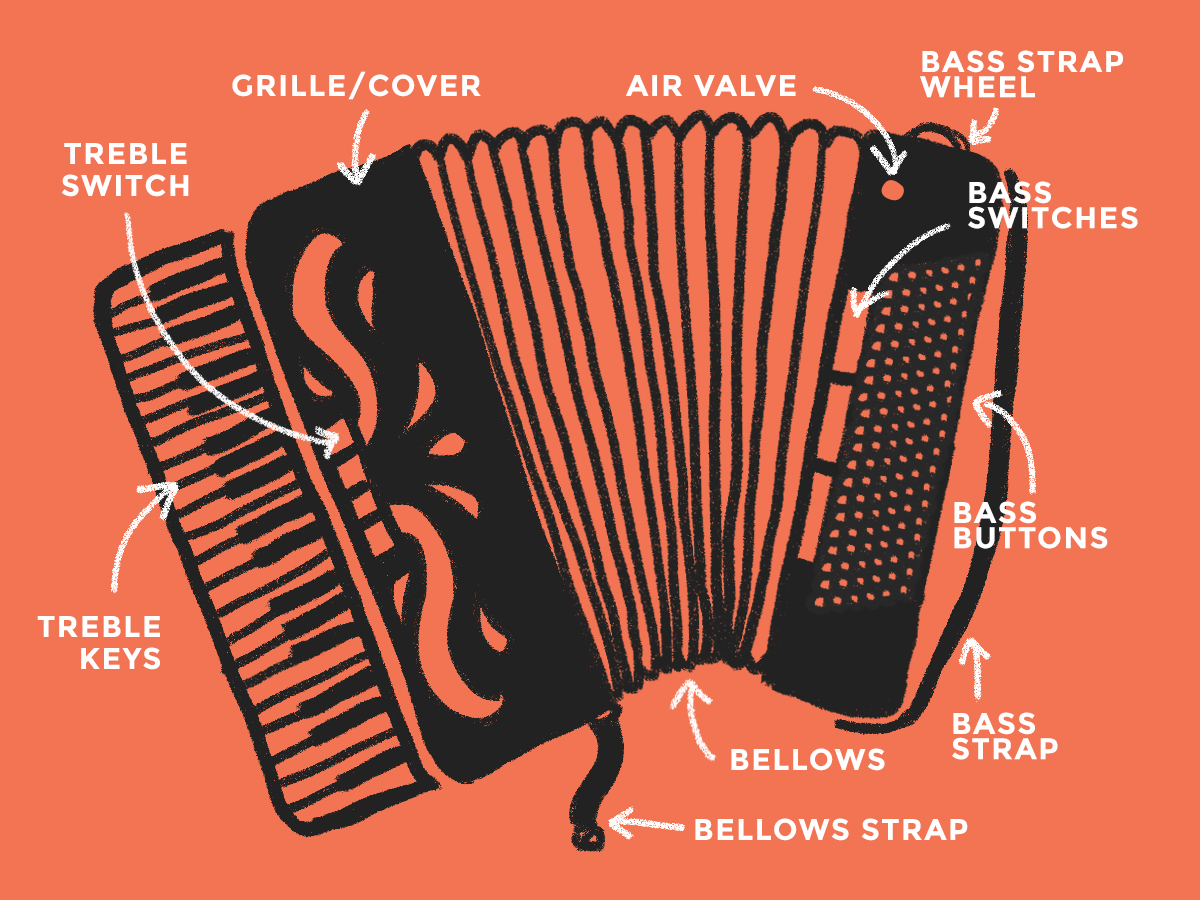
To start off, here's a quick overview of the parts of an accordion and list of its functions.
accordion, accordion anatomy, parts of the accordion, accordion parts

  • Treble Keys – plays the treble, always located on the right of the accordion except concertinas since it would be on both sides.
  • Treble Switches – also called couplers, these switch between voices/reed sets.
  • Grille/Cover – protects the reeds and makes your accordion look pretty. Also, air flow!
  • Bass Buttons – plays bass, located on the left of the accordion except concertinas, they have no bass. The note C always has some sort of indentation for easy access.
  • Bass Switches – just like treble switches, only for bass.
  • Bass Strap – for controlling the bellows by slipping your hand under and letting it rest on your wrist. You wouldn't want it too loose or too tight but rather sufficiently snug with your palm always on the accordion for bellows control.
  • Bass Strap Wheel – for tightening or loosening the bass strap. Rotate it away from you to tighten, and vice-versa. Be careful when loosening, you might just cause it to fall out.
  • Bellows – pretty much the lifeblood of the accordion, it creates the sound. Try pressing a note without moving the bellows and you won't hear a thing. Make sure not to push/pull on it if you're not playing anything because that screws something up.
  • Air Valve – the button you press to move the bellows when you're not playing anything.
  • Bellows Strap – to protect your bellows from going everywhere when not in play.
  • Shoulder/Back Strap – holds the accordion in place and keeps it from accidentally falling off of you when you play. The right strap should be longer than the left since it's the left strap that will mostly carry the weight. This also helps position the accordion correctly. The back strap is for additional support. Has anyone actually succesfully played the accordion without shoulder straps?


Quick Set-up

Got your accordion? Good, unless it's a concertina because these would not apply to you. Now please take a seat, wear the straps and position the accordion in a way that the treble part is at the center of your body and the grille is sitting on your left knee. Make sure not to let the bellows snag onto anything because it would eventually get damaged and you'd have a hard time pushing and pulling.

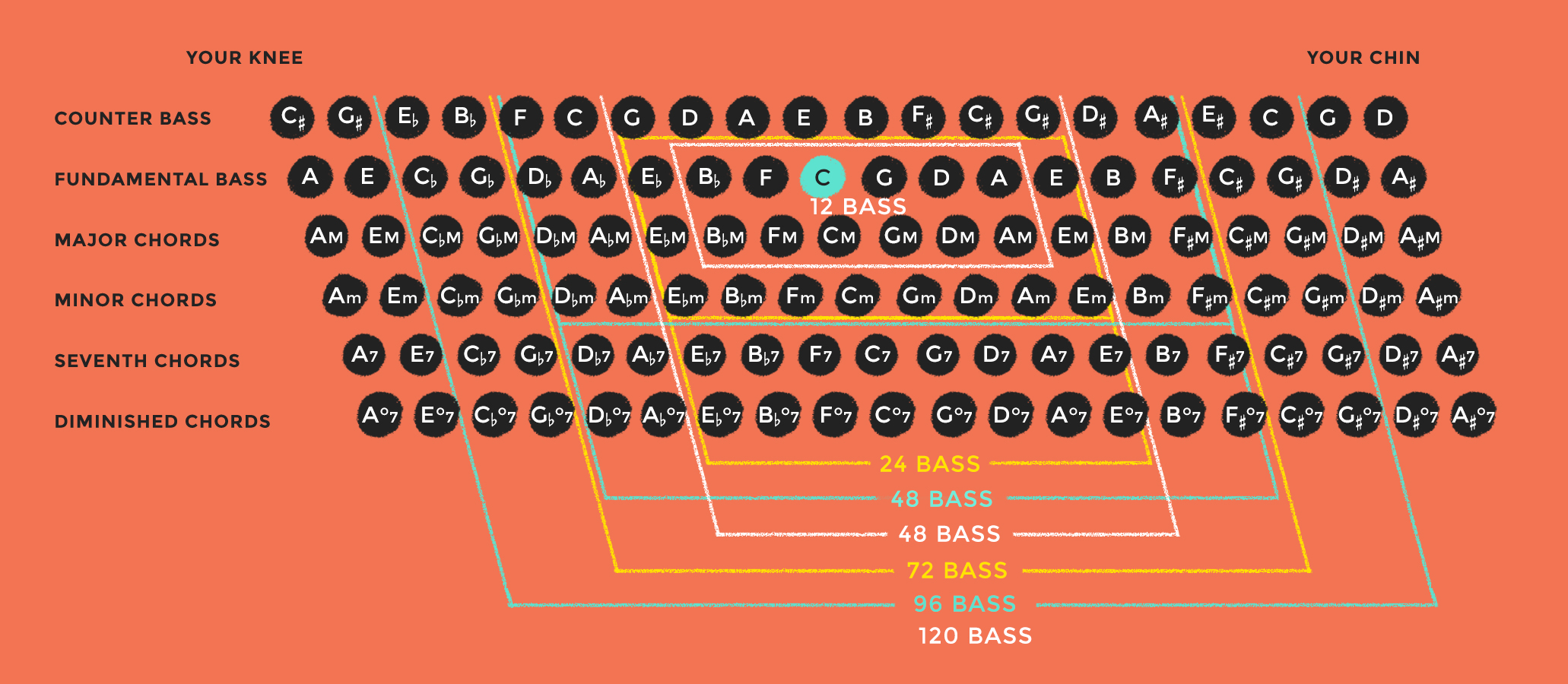
And here's a bass button reference for your possibly chromatic accordion in the Stradella system be it piano or button. Click the image to download! accordion bass, accordion bass chart, stradella

Finally time to learn!

Everyone says you should get an actual tutor so that they could tell you what you're doing wrong and stop you from forming bad habits but sadly not everyone has access to one. As I am not really equipped to teach (I'm learning myself, haha), here's a list of links to people who are very good at it and plus, all for free!

Piano Accordion
  • Palmer-Hughes Accordion Course Book – Okay, not exactly a person and not free either. Always recommended though for anyone looking to learn as it's probably what most students learn from hence the special mention.
  • Duane Schnur – A retired accordion teacher who wants to give back, thank your lucky stars. Only teaches the piano accordion, provides lessons in pdf forms and mp3 explanations.
  • Play and Teach – Thorough video lessons for the piano accordion and a bunch of songs taught by a generous English man originally meant for his brother-in-law.
  • Mosche Zuchter – Another nice young man who teaches techniques and lots of tutorials for contemporary music for the piano accordion. Takes requests and has a patreon if you want to support him.
Chromatic Button Accordion
Diatonic Button Accordion
Concertina