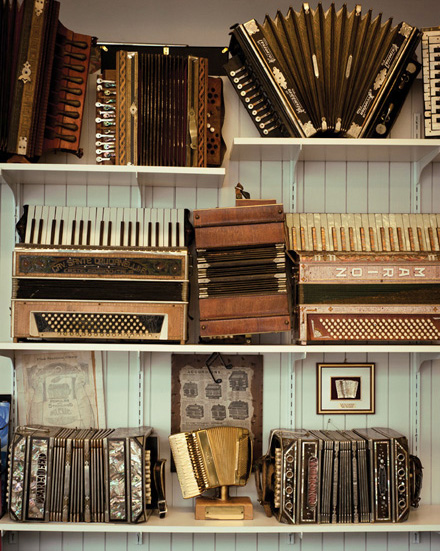
accordion to theory, accordion, accordionist
Photo by Bob MacCallum

Soo..What's your type?

Generally, accordions are grouped into 4 classifications, namely:

    piano accordion
  1. Piano Accordion – the most popular type especially in the US, meaning more widely accessible compared to the rest. Because of the piano keys, it's a lot easier to understand and those with keyboard experience will of course have an easier time with this. Keys to its left, bass buttons to the right. Comes in a lot of sizes starting from 20 key, 12 bass all the way up to the full 41 key, 120 bass. The bass comes in either Stradella or free bass system. When a key/button is pressed as the bellows are pushed/pulled in either direction, the same note is played which makes it unisonoric.
  2. chromatic accordion, chromatic button accordion, button box
  3. Chromatic Button Accordion – more popular in Europe called the Russian Bayan. Similar to the piano accordion, when you press a button/key, the same note is played even if you push/pull the bellows unlike the diatonic. Both sides consist of buttons which makes it easier for your fingers to reach notes, with its left consisting of bass buttons in either Stradella or free bass system and 3-5 rows of chromatically arranged buttons on the right.
  4. diatonic accordion, button box
  5. Diatonic Button Accordion – also known as the melodeon and usually used in folk and Cajun music. Typically consisting of 2-3 rows of buttons in the diatonic scale, it also uses buttons except it is bisonoric, meaning pressing one button and pushing/pulling the bellows will get you 2 different notes instead of the same, similar to the harmonica. Its bass system is also different with a certain number of buttons per treble buttons on its right side. There are some diatonic accordions that are unisonoric though.
  6. accordion, concertina
  7. Concertina – is also diatonic and comes in hexagonal/octagonal shapes with straps for your hands instead of your back, making it very lightweight and compact compared to the others. The number of buttons vary per instrument and is usually used in traditional English, Irish and German music. The concertina does not have bass, thus only plays melodies.
Perhaps you're wondering what is the Stradella and free bass system. The stradella bass system is used on most accordions and plays fixed chords on certain rows while the free bass system plays individual notes and is commonly used by classical players.

A lot to take in, but basically just choose whatever instrument will suit you and the sort of music you're looking to play. Search who plays what on YouTube and give it a listen or better yet go to your friendly neighborhood accordion store and try some out. Note that if you're based in the US, most accordions are piano accordions in the stradella and it seems like a lot of resources for learning online are the same. Don't let that hinder you though, you just keep doing you.

Further knowledge
About all those other stuff

Lucky you, I've compiled a list of things to consider before deciding on one! Let's run through them:

  • Number of Keys/Bass and Size – accordions go up in size as the number of keys/buttons increase. Most recommend that beginners start with a 48 bass as they say more bass makes the weight significantly heavier but Petosa disagrees. Starting with too little bass might make you outgrow it in no time. By the way, it's recommended that when sitting, the accordion stays below your chin.
  • Reeds/Voices – what produces the sound in the accordion are the vibrating reeds as air goes through, which comes in sets and in turn becomes the "voice" of the accordion. For example, most come as two-voice and in the middle pitch "M" or rather written as "MM" or "M+". While both reed sets are tuned M, one is slightly off to make that vibrating-y sound known as "tremolo." Three-voice instruments are usually "MM" with an additional voice tuned lower which makes it "LMM" and so on and so forth.
  • Tuning – of which there are 2 kinds in several degrees: dry and wet. The vibrations made by playing are called "beats" which are the soundwaves basically crashing into each other. The more "beats" the wetter the sound while dry-tuning makes no beats. Definitely check out the tunings guide below by Steve Dumpleton to learn more.

Further knowledge

Now how do we buy?

Oooh, are you ready? Here's some stuff to watch out for!

  1. Brand actually matters? Many say that Chinese brands are not as durable as Western ones due to parts being of lower quality therefore lower price. But nowadays, some extremely reputable brands such as Hohner outsource to China with some models ending up either pretty good still or not so good at all. Also, the brand of your accordion affects its value. Check below for the list of known Chinese manufacturers and European brands.
  2. It's what's on the inside that counts. Just because it looks all pretty on the outside doesn't mean it's just as pretty on the inside. The reeds could be completely damaged for all we know. But seeing missing parts such as screws, etc. will prove to be a problem too.
  3. No leakage, please! Bellows should have difficulty in being pushed/pulled when no key/button is pressed. If you hear a hissing sound, there's probably an air leak.
  4. Mold is bad. This kills the accordion. You could usually tell by sight or by smell which apparently smells damp, probably like laundry kept from the shade.
  5. Stuff better be in place. Make sure that no single button/key sticks out and/or stays depressed. Best to check by testing every single one of them. Hearing rattling sounds inside when you move the accordion is no good as it probably means the reeds are loose and having it repaired will be real costly.
  6. Try to browse in person, as in physically. This is the safest way to check everything (even the straps) and that it fits you. Otherwise, you'll have to gamble a bit on buying used ones.
Further knowledge
petosa accordions, accordion museum, accordions
Photo by Nate Watters viaCityArts